
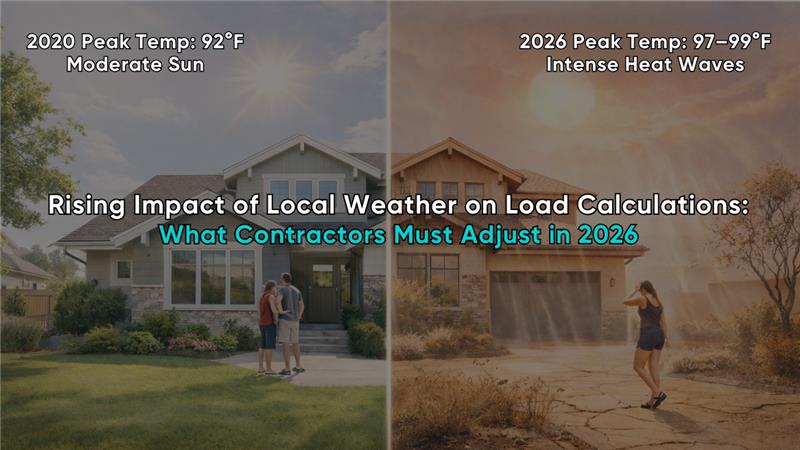
The Rising Impact of Local Weather Extremes on Load Calculations: What Contractors Must Adjust in 2026
The design temperatures you used five years ago may no longer reflect the reality your customers are living in today.
Hotter summers. Longer heat waves. Colder surprise snaps in places that rarely saw them before. Higher humidity that lingers for weeks. If you’re sizing equipment based on outdated weather assumptions, you may be setting yourself up for callbacks, uncomfortable customers, and systems that never quite perform the way they should.
In 2026, HVAC contractors can’t rely on generic regional averages alone. Local weather extremes are directly impacting HVAC load calculations and the margin for error is shrinking.
In this article, we’ll break down:
- What’s actually changing in local weather patterns
- How does that affect heat load and cooling load calculations
- What practical adjustments do contractors need to make
- How modern software and updated data can protect your reputation
What Is an HVAC Load Calculation and Why Local Weather Now Matters More Than Ever?
At its simplest, an HVAC load calculation determines how much heating and cooling a building needs to stay comfortable. In technical terms, a proper load calculation (often based on ACCA Manual J principles) accounts for:
- Outdoor design temperature
- Indoor setpoint temperature
- Insulation levels
- Window size and orientation
- Air infiltration
- Duct losses
- Internal gains (people, lighting, appliances)
Historically, contractors relied on long-term climate averages for a given city or region. That worked reasonably well when weather patterns were relatively stable.
But today, we’re seeing:
- Higher peak temperatures
- More frequent multi-day extreme heat events
- Sudden cold snaps in moderate climates
- Rising humidity levels in many regions
When outdoor conditions exceed traditional “design day” assumptions more often, systems sized to older data may:
- Run continuously
- Struggle to maintain setpoints
- Fail to control humidity
- Wear out faster
And when customers are uncomfortable, they don’t blame the weather; they blame the contractor.
What’s Changing in Local Weather Patterns in 2026?

While climate trends are discussed nationally, HVAC performance is hyper-local. What matters is what’s happening in your service area.
Here are the key shifts contractors are feeling on the ground:
1. Hotter and Longer Cooling Seasons
Many regions are experiencing:
- Earlier spring warmups
- Extended late-summer heat
- More days above historical design temperatures
Cooling systems are running longer each year, increasing:
- Runtime hours
- Energy use
- Equipment stress
2. Higher Humidity in Unexpected Areas
Humidity is often overlooked in basic load assumptions. But higher latent loads mean:
- Systems must remove more moisture
- Oversized equipment, short cycles, and leaves homes damp
- Mold and comfort complaints increase
3. More Frequent Temperature Swings
Sudden weather shifts create performance challenges:
- Heat pumps struggling in surprise cold snaps
- Dual-fuel systems switch more often
- Equipment operating outside expected design envelopes
If your load calculation doesn’t reflect updated outdoor design data, you’re building risk into every proposal.
How Local Weather Extremes Affect HVAC Load Calculations
Let’s make this practical.
When local weather becomes more extreme, it directly changes:
1. Peak Cooling Load
Higher outdoor design temperatures increase:
- Sensible heat gain through walls and windows
- Solar heat gain
- Equipment sizing requirements
Even a 3–5°F shift in design temperature can significantly increase required BTUs.
2. Latent (Moisture) Load
Higher dew points increase:
- Moisture removal demand
- Runtime requirements
- Risk of comfort complaints
If the latent load is underestimated, customers may say:
“It’s cool, but it still feels sticky.”
3. Heating Load Variability
In traditionally mild regions, unexpected cold snaps can expose:
- Undersized heat pumps
- Poor backup heat strategies
- Over-optimistic assumptions about winter lows
4. Equipment Longevity
Systems sized too tightly against outdated weather data may:
- Run at maximum capacity more frequently
- Experience higher wear and tear
- Fail earlier than expected
What Contractors Must Adjust in 2026
Here’s where it becomes actionable.
1. Update Outdoor Design Data Regularly
Don’t rely on decade-old climate tables.
Use updated, location-specific weather data for:
- Heating design temperature
- Cooling design temperature
- Humidity and dew point averages
Even small adjustments improve long-term performance.
2. Account for Latent Load More Carefully
Humidity is no longer a “secondary” concern.
In humid regions, especially:
- Pay close attention to SHR (Sensible Heat Ratio)
- Avoid oversizing equipment
- Consider variable-speed systems
Proper moisture control protects comfort and your reputation.
3. Be More Cautious with “Rule of Thumb” Sizing
Rules like “500 sq ft per ton” are more dangerous than ever.
Extreme weather amplifies errors.
A detailed load calculation:
- Reduces callbacks
- Justifies equipment recommendations
- Builds trust during sales conversations
4. Revisit Duct and Envelope Assumptions
Higher temperature differences mean:
- Duct losses matter more
- Poor attic insulation becomes more expensive
- Air leakage drives up peak loads
Contractors who understand whole-home performance will stand out in 2026.
Common Challenges Contractors Are Facing
“My system used to work fine. Now it can’t keep up.”
Often caused by:
- Hotter peak days
- Increased humidity
- Envelope degradation over time
Solution: Recalculate load using updated weather data before recommending equipment replacement.
Customers Blaming Equipment Instead of Conditions
Homeowners don’t track design temperatures. They just know they’re uncomfortable.
Solution:
Use clear, visual heat load reports to explain:
- What the home needs
- What the system delivers
- Why updated design data matters
Transparency builds trust.
Overcompensating by Oversizing
When contractors see higher temperatures, the instinct is to “go bigger.”
That often leads to:
- Short cycling
- Poor humidity control
- Higher energy bills
The fix is not guessing, it’s calculating.
Best Practices for Load Calculations in a Changing Climate
Use this checklist in 2026:
- ✅ Verify local outdoor design temperatures annually
- ✅ Include accurate humidity data
- ✅ Measure, don’t assume, insulation values
- ✅ Evaluate duct leakage realistically
- ✅ Avoid square-foot shortcuts
- ✅ Present load reports to customers as part of the sales process
Load calculations are no longer just a compliance step. They’re a competitive advantage.
Conclusion – How Energy Design Systems (EDS) Helps You Stay Accurate in 2026
As local weather extremes become more common, the gap between contractors who calculate properly and those who guess will only widen.
Accurate, updated HVAC load calculations:
- Protect your reputation
- Reduce callbacks
- Improve customer comfort
- Extend equipment life
- Strengthen your sales process
Energy Design Systems (EDS) provides cloud-based HVAC load calculation software that uses current, location-specific data to generate clear, professional heat load reports. Instead of relying on outdated tables or spreadsheets, you can quickly produce accurate reports that reflect today’s climate reality.
For contractors offering whole-home evaluations, EDS also supports detailed home energy reports that help explain performance issues tied to insulation, infiltration, and extreme weather impacts.
In 2026, extreme weather isn’t rare; it’s part of the design landscape. The contractors who adapt their load calculations to today’s climate realities will outperform those who rely on outdated assumptions.
Book a demo with Energy Design Systems and see how updated, location-specific data can protect your installs in 2026 and beyond.
Related posts
-
![HVAC Software]()
HVAC Software – Reasons That Makes It a Worthy Investment For HVAC Service Providers
You know the HVAC industry and you are well-aware of what it takes to deliver exceptional field services. Heat and cooling load calculation is a fundamental service every HVAC designer and consultant should provide to help homeowners get the appropriate HVAC system solution. An appropriately sized heat and cooling system not just provides the right-sized…
-
![Hvac Business Software]()
Hand-picked Marketing Strategies To Help You Boost Your HVAC Business Revenue
Modern homeowners turn to Google to find the HVAC system provider near them. There are not one or two HVAC companies out there, the number is quite huge. There are more than a hundred thousand HVAC businesses in the United States. And each one is competing to be in the $81.1 billion per year…

