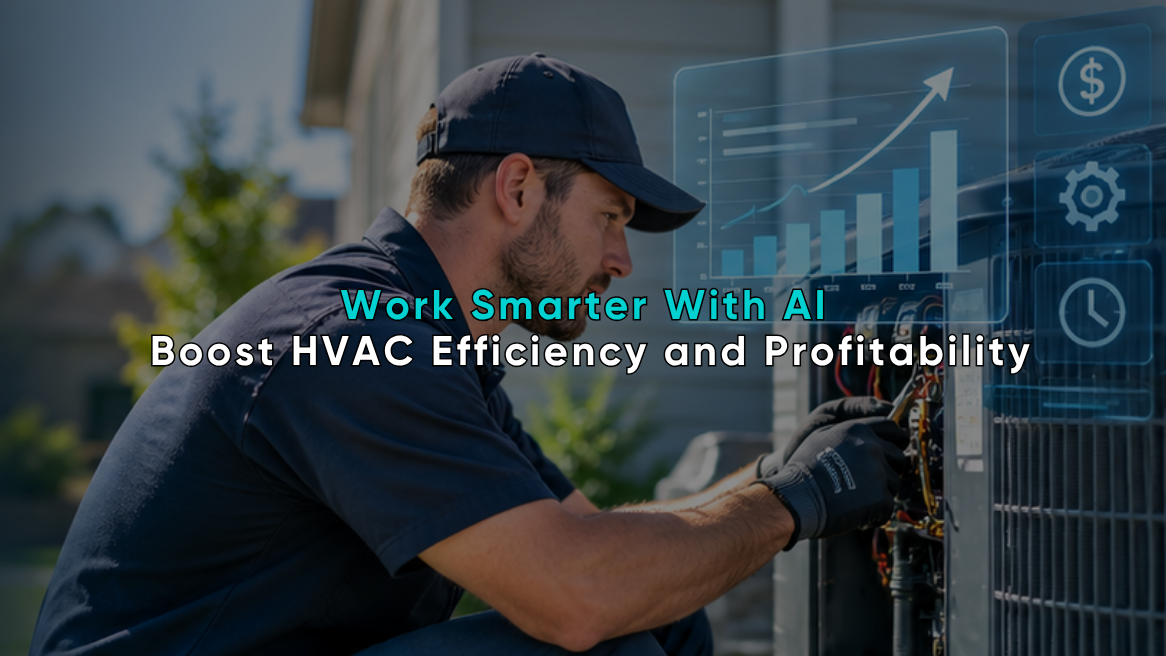
“How AI Improves HVAC Job Profitability (Beyond Lead Generation)”
AI gets plenty of attention in HVAC marketing. Contractors hear about automated follow-ups, smarter ad targeting, chatbots, and lead scoring.
Those tools can help bring opportunities into the business. But getting more leads does not automatically make those jobs profitable.
The bigger opportunity is what happens after the lead comes in.
Modern HVAC profitability software can help contractors understand job costs, identify margin problems, improve pricing decisions, reduce wasted labor, and learn which types of work actually produce the strongest returns.
That changes AI from a marketing tool into an operating tool.
For HVAC companies trying to grow without watching margins disappear, that distinction matters.
More Revenue Does Not Always Mean More Profit
A contractor can have a full schedule and still struggle with profitability.
Consider two replacement jobs that each bring in $12,000 in revenue. On paper, they look identical. In practice, one may require:
- Fewer labor hours
- Less travel time
- Fewer return visits
- Better equipment and material purchasing
- Less administrative work
- More accurate estimating
- No unexpected installation complications
The second job may suffer from several of those problems and generate substantially less profit.
Revenue tells you what came in.
Profitability tells you what was left after the work was actually completed.
That is why better HVAC business intelligence needs to go deeper than closed sales and total revenue.
Contractors need to know what happened at the job level.
AI HVAC Business Analytics Can Find Problems That Basic Reports Miss
Most HVAC businesses already collect useful operational data.
It may live across estimating tools, spreadsheets, accounting systems, CRMs, dispatch platforms, service records, marketing software, and technician notes.
The real problem usually isn’t a lack of data; it’s turning the data that already exists into something usable.
AI HVAC business analytics can help identify patterns across larger sets of operational information more quickly than manually reviewing reports.
For example, analytics may reveal that:
- A certain category of replacement work consistently runs over estimated labor hours.
- Jobs in a particular service area have higher travel costs.
- One maintenance plan produces substantially better renewal economics than another.
- A specific type of job has strong revenue but weak gross margins.
- Estimates within a certain price range convert well without sacrificing profitability.
- Certain callbacks repeatedly appear after similar types of work.
These findings can give an owner or manager something useful to investigate.
AI works best as a support to financial judgment, surfacing patterns a manager might otherwise miss.
HVAC Job Costing Software Makes Profitability Visible at the Job Level
You cannot improve a margin problem you cannot locate.
That is why HVAC job costing software is so important.
Effective job costing compares expected costs with what actually happened. Depending on the business and type of work, contractors may track:
- Equipment
- Materials
- Direct labor
- Labor burden
- Subcontractor costs
- Permits
- Travel
- Disposal
- Financing expenses
- Commissions
- Other direct project costs
Suppose your estimate assumes 16 labor hours, but the installation consistently takes 21.
That five-hour difference may seem small when reviewing one job. Multiply it across dozens or hundreds of projects, and it becomes a significant profitability issue.
The important question then becomes why the estimate and actual result are different.
Possibilities include:
- The labor allowance is unrealistic.
- Certain properties consistently require more installation time.
- Crews are encountering predictable site conditions that are not reflected in pricing.
- Scheduling or material problems are creating idle time.
- The company is selling work too aggressively without protecting the required margin.
AI-assisted analysis makes these recurring differences easier to spot.
Estimated Versus Actual Costs Are Where the Learning Happens
Historical job costing becomes more useful when it influences future estimates.
If completed projects repeatedly show that a particular type of installation needs additional labor, future estimates should account for it.
If another job category routinely finishes below budget, you may have more pricing flexibility than expected.
The real aim is a feedback loop, not another static report:
Estimate → Perform the work → Measure actual costs → Identify the variance → Improve the next estimate
That is where profitability data becomes operationally valuable.
HVAC Pricing Optimization Should Start With Your Own Cost Structure
Pricing is often treated as a competitive question:
“What is everyone else charging?”
That information can provide context, but it should not determine your price.
Two HVAC companies can perform similar work and have completely different cost structures.
One may have:
- Higher labor costs
- More overhead
- Longer drive times
- Different financing expenses
- Better purchasing terms
- Higher marketing costs
- Different callback rates
A price that works for one contractor may be unprofitable for another.
HVAC pricing optimization works better when decisions are based on your actual operating data.
That means understanding:
- Your required margin
- Historical labor performance
- Typical job costs
- Overhead requirements
- Conversion rates
- Maintenance economics
- Financing impacts
- Callback and warranty costs
AI can assist by finding relationships between those variables.
For example, you may discover that slightly increasing prices on certain work has little effect on close rates but meaningfully improves gross profit.
Or the opposite may be true: a particular service category could tolerate a different pricing approach because it is already highly efficient to deliver.
That is a much stronger pricing strategy than simply applying the same markup everywhere.
Read: How HVAC Job Costing Helps Contractors Protect Margins
A useful internal article here could explain how contractors should compare estimated and actual labor, materials, overhead, and gross profit by job type.
Labor Efficiency Is One of the Biggest Profitability Levers
Labor is particularly important because wasted time is difficult to recover.
If a technician loses 30 minutes because necessary information was missing, the business cannot store that half hour for another day.
AI and automation can improve labor economics by reducing administrative friction around the job.
Examples include:
- Automatically organizing information before an appointment
- Reducing duplicate data entry
- Connecting sales information with operational systems
- Standardizing calculations and reports
- Flagging incomplete project information
- Automating follow-up tasks
- Moving data between CRM and operational platforms
Saving a few minutes once is not transformational.
Saving a few minutes across every estimate, audit, maintenance quote, and customer handoff can be.
For a company completing thousands of interactions each year, workflow efficiency eventually becomes a margin issue.
AI Can Help Contractors Identify Their Most Profitable Work
Many businesses know which services generate the most revenue.
Fewer know which generate the best economic return.
Those are not always the same thing.
An HVAC ROI tool can help compare job categories using measures such as:
- Revenue per job
- Gross profit dollars
- Gross margin percentage
- Labor hours required
- Revenue per labor hour
- Callback frequency
- Sales conversion rate
- Customer acquisition cost
- Repeat-service potential
Imagine that one type of project averages $15,000 in revenue while another averages only $7,500.
The larger project sounds more valuable.
But what if the $7,500 job requires less labor dramatically, has fewer callbacks, closes more frequently, and generates a better margin?
Now the business has a very different picture.
The point isn’t necessarily to stop selling the first type of work, it’s understanding how each job contributes so pricing, staffing, and marketing decisions reflect that.
Maintenance Plans Need Profitability Analysis Too
Maintenance agreements are often evaluated primarily by the number of memberships sold.
That metric only tells part of the story.
A maintenance plan also needs to make economic sense.
Contractors should understand:
- Planned visit costs
- Expected technician time
- Discounts provided
- Administrative expenses
- Renewal rates
- Additional service revenue
- Replacement opportunities
- Customer retention value
Pricing maintenance plans without understanding those variables can result in a program that grows quickly but creates more workload than profit.
Software can help contractors model and price maintenance options with greater consistency.
Energy Design Systems (EDS), for example, supports workflows that can help contractors price maintenance plans alongside other customer-facing calculations and reports.
That creates a more structured process instead of relying on rough assumptions.
Read: How to Price HVAC Maintenance Plans Without Guessing
This would be a useful supporting article covering technician time, visit frequency, overhead, discounts, and target margins. Read Here
Better Property Data Can Improve the Economics of the Sale
Profitability decisions begin before the job is sold.
The more accurately a contractor understands a home, the easier it becomes to have a productive customer conversation and develop recommendations based on actual property conditions.
That is where tools such as the EDS HVAC Home Auditor can support the workflow.
A structured home energy report can help contractors gather and present information about the property in a way homeowners can understand.
This can support better conversations around:
- Comfort concerns
- Energy use
- Building characteristics
- Potential improvements
- Equipment-related recommendations
The real value is reducing guesswork during the sales and assessment process, not the report itself.
Better information can help the contractor recommend work with more confidence while giving the customer clearer reasoning behind those recommendations.
HVAC ROI Tools Should Connect Sales Decisions With Operational Results
Most companies measure sales teams on metrics such as close rate and total revenue.
Those numbers matter, but they can create the wrong incentives when viewed alone.
Imagine two salespeople.
One sells $1.2 million of work with weak margins and frequent estimate overruns.
Another sells $950,000 while consistently producing healthier margins, fewer pricing exceptions, and more predictable jobs.
Who is generating more value?
The answer cannot be determined from sales volume alone.
Better HVAC ROI tools connect front-end sales activity with back-end job performance.
Useful questions include:
- Which sold jobs produce the strongest margins?
- Which estimates routinely miss actual labor requirements?
- Which financing options affect net profitability?
- Which service categories produce the highest profit per labor hour?
- Which sales channels generate customers who buy profitable work?
- Which promotions create revenue without adequate margin?
Once contractors can answer those questions, sales strategy becomes much more disciplined.
AI Is Most Valuable When It Connects the Systems You Already Use
HVAC companies rarely operate from one platform.
A typical technology stack may include a CRM, field-service platform, accounting software, advertising platforms, estimating tools, reporting tools, and spreadsheets.
That fragmentation creates two problems.
First, employees spend time moving information between systems.
Second, managers struggle to get a complete picture of business performance.
AI and automation become much more useful when information can move between those systems.
Integrations with platforms and automation tools such as ServiceTitan, Zapier, CRM systems, or marketing platforms can reduce manual handoffs and make operational data easier to act on.
The goal is eliminating unnecessary work and making better use of information the business already collects, not adding AI for its own sake.
The Best AI Profitability Strategy Starts With a Few Questions
You do not need a massive analytics project to begin improving HVAC profitability.
Start with the questions that directly affect your margins.
Ask:
- Which jobs make us the most money after direct costs?
- Which jobs repeatedly exceed estimated labor?
- Where do callbacks occur most frequently?
- Which types of work produce the most gross profit per technician hour?
- Are our maintenance plans priced appropriately?
- Which sales channels produce profitable customers rather than simply leads?
- Where is staff spending time manually transferring or re-entering information?
Then determine whether your existing software can provide the data.
Once the underlying information is available, AI becomes far more useful.
Without reliable inputs, even the most sophisticated analytics platform is just producing faster guesses.
HVAC Profitability Software Should Help You Make Better Decisions
AI in HVAC is bigger than lead generation.
Its strongest long-term value may come from helping contractors understand what happens after the phone rings.
With better HVAC profitability software, contractors can connect estimating, job costing, pricing, labor efficiency, home assessments, maintenance plans, and business analytics into a clearer picture of performance.
Energy Design Systems (EDS) supports that process through tools for heat load reports, home energy reports, maintenance-plan pricing, automation, and connected HVAC workflows.
The objective is understanding which work is profitable, why, and using that to make the next job better, not simply adopting more technology.
Related posts
-
![Cooling Load Calculation]()
Important factors of Cooling Load Calculation and how it is calculated
Every home needs a perfect amount of cooling to make the atmosphere comfortable. However, achieving a comfortable level is entirely dependent on having the right-sized home air conditioning unit. But how do you make sure your cooling system is correctly sized? Well, you can get help from the professionals providing cooling load calculation services. Also,…
-
![Best HVAC Software]()
The 5 Best HVAC Software Options for Your Small Business
With so many of us following the new normal of “work from home” culture, it is no wonder that the demand for global energy will rise. And that is having a positive impact on the HVAC service providers. It is predicted that more than 50,000 new jobs will be available over the next decade. So,…

