
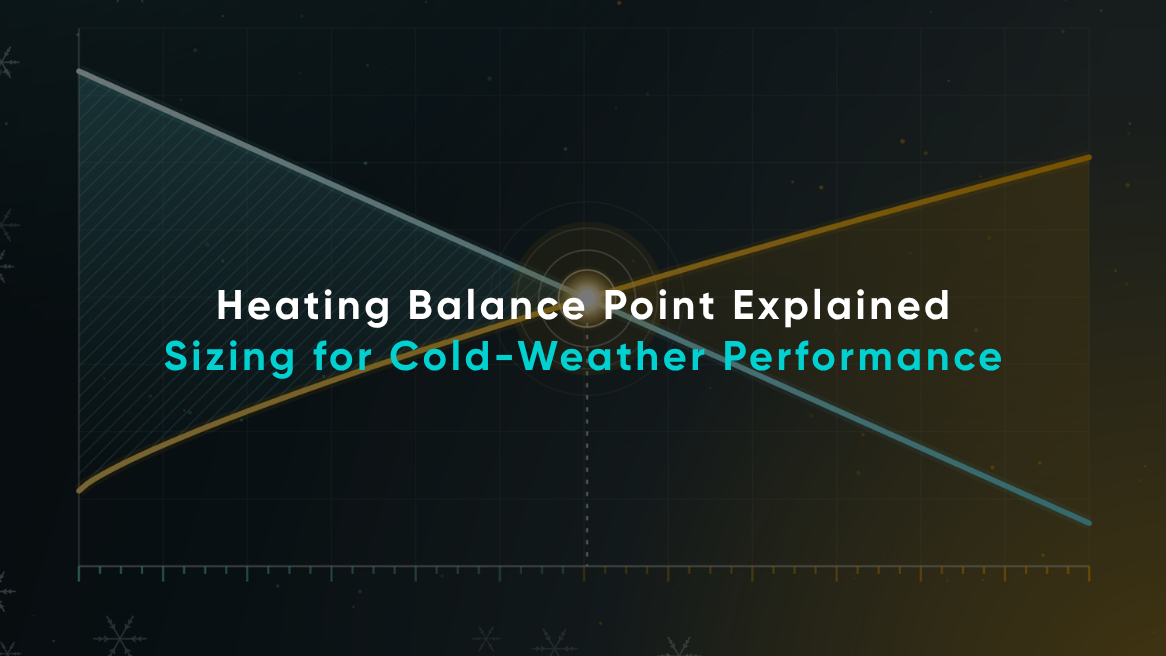
Heating Balance Point Explained: A Better Way to Size Heat Pumps for Cold-Weather Performance
A heat pump that looks perfectly sized on paper can still disappoint a homeowner on the coldest mornings of the year.
The usual explanation is that the outdoor temperature dropped too low, which is only part of the story.
What really matters is the relationship between two numbers: how much heat the building needs as outdoor temperatures fall and how much heat the heat pump can actually deliver at those temperatures.
The point where those two meet is the heating balance point.
For HVAC contractors, understanding the heating balance point creates a better way to think about heat pump sizing. Instead of asking only, “What size heat pump matches this home’s design load?” you can ask a more useful question:
At what outdoor temperature does this particular heat pump stop carrying the building’s heating load by itself?
That distinction becomes increasingly important as contractors install more heat pumps in colder climates.
What Is the Heating Balance Point?
The heating balance point is the outdoor temperature at which a heat pump’s available heating capacity is equal to the home’s heating requirement.
Above that temperature, the heat pump can generally maintain the indoor setpoint without supplemental heat.
Below it, the building requires more heat than the heat pump can supply under those operating conditions, and supplemental heat may be needed to make up the difference.
Consider a simple example.
Suppose a home’s calculated heating requirement changes roughly like this:
- 25,000 Btu/h at 35°F
- 35,000 Btu/h at 25°F
- 45,000 Btu/h at 15°F
- 55,000 Btu/h at 5°F
Now suppose the selected heat pump delivers:
- 42,000 Btu/h at 35°F
- 38,000 Btu/h at 25°F
- 34,000 Btu/h at 15°F
- 30,000 Btu/h at 5°F
Somewhere between 25°F and 15°F (at roughly 23°F, if both curves are treated as straight lines), the home’s load overtakes the heat pump’s available capacity. That intersection is the heating balance point.
Once you see the system this way, cold-weather heat-pump performance becomes much easier to explain.
Heating Load Goes Up While Heat Pump Capacity Can Go Down
This is the central sizing problem. As outdoor temperature falls, heat leaves the house faster, and the building’s heating requirement increases.
At the same time, the heating output of an air-source heat pump can change with outdoor conditions. The exact performance depends on the equipment.
So you have two curves moving toward each other: the building load curve rises as it gets colder, while the heat pump capacity curve varies with temperature and often falls as conditions become more demanding. Where those curves intersect matters far more than nominal tonnage.
A unit sold as a “3-ton heat pump” does not necessarily provide 36,000 Btu/h of heating across every outdoor temperature.
Contractors need to look at actual manufacturer performance data for the model being considered.
Heating Balance Point Is Not the Same as the Building’s Balance Temperature
HVAC terminology can get confusing here because “balance point” is used in several contexts.
A building can have a thermal balance temperature: the outdoor temperature below which the building needs mechanical heating after accounting for internal heat gains, solar gains, and other factors.
A heat-pump system can also have an equipment balance point: the temperature at which the heat pump’s available output equals the building’s heating load.
For replacement and equipment-sizing work, the second concept is usually the more actionable one.
Contractors want to know when the chosen equipment will need help, because that answer shapes:
- Expected supplemental heat use
- Cold-weather comfort
- Electrical demand
- Operating behavior
- Whether a different equipment selection makes sense
Terminology varies across manufacturers and controls, so always verify what “balance point” means in the documentation you are using.
Why Design-Temperature Sizing Alone Can Be Misleading
Heating load calculations frequently focus on an outdoor design condition.
That step is necessary, since you need to know the structure’s heating requirement during challenging weather. The mistake comes after you have that number.
Suppose a heat load report shows that the house needs 48,000 Btu/h at the applicable winter design condition.
It is tempting to search for a heat pump with a nominal heating capacity around 48,000 Btu/h and call the sizing process finished, but the job is only half done until you know what that equipment produces at the relevant outdoor temperature.
A heat pump rated at 48,000 Btu/h under one test condition may provide a different amount when outdoor temperatures fall.
The useful comparison is the building’s heating requirement at a given outdoor temperature against the equipment’s heating capacity at that same temperature.
A Bigger Heat Pump Is Not Automatically the Answer
Once contractors understand the heating balance point, the obvious reaction can be to select larger equipment so the heat pump carries the load at a lower outdoor temperature.
Sometimes that may be appropriate, but sizing solely for the worst heating condition creates other tradeoffs. The same equipment still has to perform in mild heating weather, the cooling season, humid conditions, shoulder seasons, and long stretches of part-load operation.
A substantially larger heat pump may behave differently during those conditions than one selected around the home’s broader heating and cooling needs.
Modern variable-capacity systems can reduce some of the problems historically associated with oversized fixed-capacity equipment, but that does not make load calculations irrelevant.
You still need to understand the building before evaluating the equipment. The more useful question is which equipment gives this home the right combination of heating capacity, cooling performance, part-load operation, and supplemental-heat requirements.
Heating balance point helps answer one part of that decision.
How to Use Heating Balance Point in a Heat Pump Replacement
A practical replacement workflow can look like this.
1. Calculate the home’s heating load
Start with the structure. Your HVAC heat load calculation should account for the factors that drive heat loss, including:
- Outdoor and indoor design temperatures
- Insulation levels
- Window and door characteristics
- Building dimensions
- Infiltration
- Exposed walls, ceilings, and floors
Do not assume the existing furnace or heat pump size proves what the house requires.
Older systems are frequently replaced based on nameplate capacity rather than the actual building load.
2. Understand how the load changes with outdoor temperature
The design heating load gives you an important endpoint, but heat loss changes as the indoor-to-outdoor temperature difference changes.
The house needs less heat in milder weather and more as temperatures fall, and mapping that relationship gives you the building side of the balance-point equation.
3. Check manufacturer heating-capacity data
Now look at the actual heat pump.
Do not stop at nominal tonnage.
Review performance information showing available heating capacity at different outdoor temperatures.
Depending on the manufacturer, you may find capacity information for conditions such as:
- 47°F
- 35°F
- 17°F
- 5°F
Cold-climate equipment may include additional low-temperature performance data.
You want to know how closely the unit’s capacity curve follows the building’s load curve.
4. Estimate where the two intersect
The temperature where required heating capacity overtakes available heat-pump capacity is your approximate equipment balance point.
If the intersection happens at 28°F, supplemental heat may be needed relatively often in a colder climate.
If it happens at 5°F, the heat pump may cover much more of the annual heating requirement before backup heat is required.
Neither number is automatically “good” or “bad.”
The right target depends on climate, equipment, utility rates, backup-heat source, electrical capacity, project budget, and the customer’s comfort expectations.
5. Evaluate supplemental heat as part of the system
Backup heat should not be treated as an afterthought.
Depending on the application, supplemental heating may come from:
- Electric resistance elements
- A furnace in a dual-fuel arrangement
- Another approved heat source
If the heat pump cannot meet the full building load below its balance point, the backup system needs enough capacity to handle the remaining requirement according to the intended system configuration.
The contractor should also understand how the controls determine when supplemental heat operates.
Balance Point Helps Explain Why Two Similar Heat Pumps Can Perform Very Differently
Imagine two heat pumps that both look like reasonable matches for a home.
At 47°F, their heating capacity may be similar.
At 17°F, the numbers may separate substantially.
One unit might still provide close to the home’s required heating capacity. The other may require significant supplemental heat.
That difference shows up well beyond the spec sheet. It can change:
- How often electric resistance heat operates
- Winter electricity consumption
- Peak electrical demand
- Customer comfort during cold weather
- How frequently the homeowner sees “auxiliary heat” on the thermostat
This is why cold-weather equipment selection needs more detail than comparing nominal capacity and efficiency ratings.
The low-temperature capacity matters.
Don’t Confuse Balance Point With a Thermostat Lockout Setting
There is another distinction worth making.
Some heat-pump controls allow contractors to configure outdoor-temperature thresholds that control when supplemental heat becomes available or when one heating source is locked out.
That control setting is not automatically the same thing as the physical balance point of the heat pump and building.
The equipment balance point comes from the intersection of:
- Building heat demand
- Heat-pump capacity
A control balance point or lockout temperature is a system setting.
Contractors may choose control strategies based on equipment performance, energy costs, comfort, utility requirements, or other project-specific considerations.
Do not assume the default thermostat setting represents the home’s actual balance point.
Cold-Climate Heat Pumps Make This Analysis More Important, Not Less
Cold-weather heat-pump technology has improved significantly.
That can tempt contractors to simplify the conversation to:
“This model works down to -5°F.”
But minimum operating temperature is not the same as adequate heating capacity.
A heat pump might continue operating at a very low temperature without providing enough output to satisfy the entire building load.
Those are different questions.
Instead of asking only:
“Will the heat pump run at 5°F?”
Ask:
“How many Btu/h will it deliver at 5°F, and how many Btu/h does this house need at 5°F?”
That is a much better sizing conversation.
Home Improvements Can Change the Heating Balance Point
The building side of the equation is not fixed forever.
If a homeowner reduces heat loss, the building’s heating-load curve drops.
That may come from:
- Better attic insulation
- Air sealing
- Improved windows
- Duct improvements
- Crawlspace or basement work
- Other building-envelope upgrades
Go back to the earlier example. If envelope improvements cut the home’s requirement at 15°F from 45,000 Btu/h to 36,000 Btu/h, the same heat pump now carries the load down to roughly 17°F instead of 23°F before supplemental heat is needed. That is an important sales and energy-audit opportunity, because you can show the homeowner how building improvements affect HVAC requirements and cold-weather performance alongside the equipment choice.
Read: How HVAC Home Audits Help Contractors Find Comfort and Efficiency Problems
Start With Accurate Heat-Load Information
Heating balance point is useful only when the building-load side of the equation is credible.
If the load calculation is wrong, the intersection with the equipment-capacity curve will also be wrong.
This is where a consistent load-calculation workflow helps.
Energy Design Systems (EDS) provides cloud-based HVAC load calculation software that helps contractors calculate residential heat loss and heat gain and produce professional reports.
For a heat-pump project, that information gives you the starting point for comparing the home’s requirements with manufacturer equipment data.
Manufacturer performance data and the final equipment decision stay with you; EDS answers the first critical question, which is how much heating the house actually needs.
Contractors can then use that information when evaluating heat-pump capacity across outdoor temperatures.
The EDS HVAC Home Auditor can also support projects where envelope improvements are part of the conversation. Showing customers where the home loses energy can help explain why reducing the load may improve comfort and change equipment requirements.
Better Heat Pump Sizing Is About Matching Two Sets of Data
Winter performance comes down to two sets of information: the home’s heating requirement across outdoor conditions and the heat pump’s available capacity across those same conditions. The heating balance point is where they come together.
For contractors, that creates a clearer way to evaluate cold-weather performance, discuss backup heat, compare equipment, and explain recommendations to customers.
The process still begins with the building.
Calculate the load accurately. Review the actual equipment performance. Find the point where the heat pump needs help.
That produces a much better heat-pump recommendation than simply matching the tonnage printed on the old unit.
Related posts
-
![Reshape HVAC Industry]()
5 Trends That Will Reshape HVAC Industry in 2024
During the year 2023, every industry has faced a huge downfall due to the coronavirus pandemic. Different industries and markets had to go beyond their traditional offerings in an effort to fulfill the sudden shift in need of their target audience. And the HVAC industry was no different than others! The HVAC industry sector has…
-
![Find the Right HVAC Software]()
7 Critical Checkpoints To Find the Right HVAC Software
If you are one of those businesses that have finally decided to use HVAC software, it might be challenging to find the right one. Today, there are plenty of options available in the market and more research even makes it more difficult to make the decision. Selecting the right HVAC load calculator or HVAC home…

