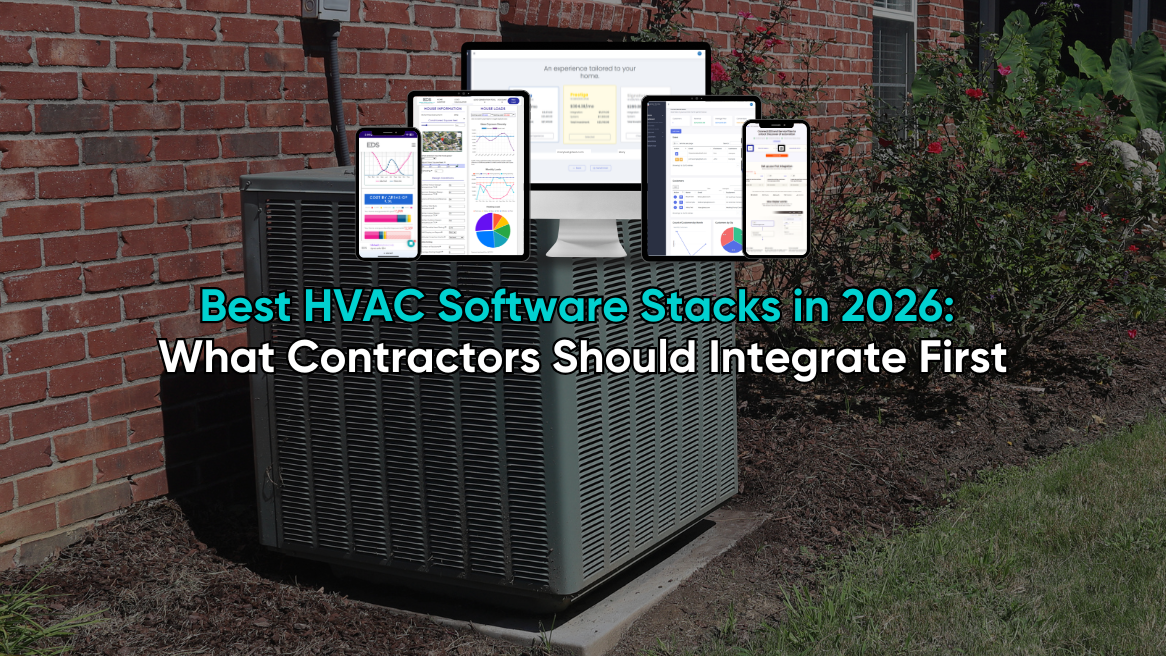
Best HVAC Software Stacks in 2026: What Contractors Should Integrate First
HVAC companies are relying more heavily on connected software systems to manage sales, service, reporting, and customer communication. In 2026, many contractors are moving away from disconnected spreadsheets and manual processes as operational complexity increases.
Instead, leading companies are building a complete HVAC software stack that connects sales, load calculations, dispatching, customer communication, invoicing, maintenance plans, and reporting into one streamlined workflow.
The challenge is that many HVAC businesses still use tools that do not communicate with each other. In many HVAC businesses, customer information still lives across multiple disconnected systems. CRM records, load calculations, maintenance agreements, and proposal data often require manual updates between teams.
That kind of disconnected workflow often leads to duplicate work, slower response times, and inconsistent customer information.
In this guide, you’ll learn:
- What an HVAC software stack actually includes
- Which HVAC business software tools matter most in 2026
- What contractors should integrate first
- How AI and automation are reshaping HVAC operations
- Why HVAC CRM + load calculator integration is becoming essential
Whether you are a growing residential contractor or a larger HVAC company looking to modernize operations, a connected software setup can make daily operations easier to manage as the business grows.
What Is an HVAC Software Stack and Why Does It Matter?
An HVAC software stack is the collection of connected software tools your business uses to manage operations, sales, customer data, service workflows, reporting, and system analysis.
Instead of relying on isolated applications, an integrated HVAC software stack allows data to move automatically between systems.
A modern all-in-one HVAC software environment often includes:
- CRM software
- HVAC load calculation tools
- Scheduling and dispatch platforms
- Estimating and proposal software
- Home energy audit tools
- Maintenance agreement management
- Marketing automation
- Payment and invoicing systems
- AI-driven analytics and reporting
The value comes from how well the systems work together. The goal is to create operational continuity across your HVAC business.
For example:
- A lead enters your CRM
- The customer schedules an estimate
- A technician performs a home energy audit
- Load calculations are generated automatically
- Proposal pricing is created from integrated data
- Maintenance plans are offered during the sales process
- Service reminders and follow-ups are automated
That connected workflow reduces manual work while improving speed and accuracy.
Why This Matters More in 2026
Several industry shifts are accelerating HVAC software adoption:
- Rising customer expectations for faster communication
- Increased focus on energy efficiency and home performance
- More competition in local HVAC markets
- Growing demand for maintenance memberships
- AI-powered customer engagement tools
- Labor shortages require higher operational efficiency
Contractors who build integrated systems now will be better positioned to scale profitably.
Key Benefits of an Integrated HVAC Software Stack
1. Faster Sales Cycles
Integrated systems reduce delays between lead generation, load calculations, proposals, and closing.
When your CRM, estimating tools, and audit software work together, your sales team can move customers through the process much faster.
That speed often improves close rates.
2. More Accurate HVAC Load Calculations
Disconnected workflows frequently lead to missing home data, duplicated entry, or outdated calculations.
Modern HVAC CRM + load calculator integration helps ensure project information stays consistent across systems.
That improves:
- System sizing accuracy
- Energy efficiency recommendations
- Customer confidence
- Proposal reliability
3. Better Customer Experience
Customers increasingly expect digital communication and quick response times.
An integrated HVAC business software stack helps automate:
- Appointment reminders
- Proposal follow-ups
- Maintenance renewal notifications
- Service history tracking
- Financing communication
This creates a more professional experience from the first call through long-term service relationships.
4. Improved Operational Efficiency
Re-entering customer and project information across systems consumes a surprising amount of office time in many HVAC businesses.
Integrated platforms reduce repetitive administrative tasks by automatically syncing information across tools.
That saves time for:
- Office staff
- Sales teams
- Technicians
- Dispatchers
- Managers
5. Stronger Maintenance Plan Revenue
Maintenance agreements are becoming a major recurring revenue source for HVAC contractors.
Software integrations make it easier to:
- Track memberships
- Automate renewals
- Schedule recurring visits
- Manage customer retention campaigns
- Upsell replacement systems
6. Better Business Visibility
Connected reporting gives owners a clearer picture of performance.
Instead of checking multiple disconnected systems, integrated dashboards can help monitor:
- Lead conversion rates
- Average ticket size
- Technician performance
- Maintenance retention
- Sales pipeline health
- Revenue trends
Core Components of the Best HVAC Software Stack in 2026
Not every contractor needs the same setup. However, the strongest HVAC software stacks usually include several key categories.
HVAC CRM Software
The CRM acts as the operational hub for customer management.
Top HVAC CRMs help manage:
- Leads
- Customer communication
- Follow-ups
- Job tracking
- Sales pipelines
- Maintenance agreements
Popular integrations often include dispatching, marketing automation, and proposal systems.
HVAC Load Calculation Software
Accurate load calculations remain foundational for system recommendations and energy efficiency.
Modern HVAC load calculation software should support:
- Accurate residential and commercial load analysis
- Fast cloud-based workflows
- Mobile accessibility
- Home energy data collection
- Integration with proposal systems
- Consistent reporting across teams
EDS offers cloud-based load calculation tools designed to simplify reporting and reduce duplicate project setup work.
Home Energy Audit Tools
Homeowners are asking more questions about comfort, airflow, insulation performance, and long-term operating costs during replacement conversations.
Home energy audit tools help contractors provide more value during consultations while creating upsell opportunities.
Integrated audit systems also strengthen proposal credibility.
EDS HVAC Home Auditor helps contractors generate detailed home energy reports while supporting sales conversations around comfort and efficiency improvements.
Scheduling and Dispatch Software
Dispatching remains one of the most important operational systems in HVAC businesses.
Integrated scheduling platforms help improve:
- Route efficiency
- Technician communication
- Appointment tracking
- Service coordination
- Job completion visibility
Proposal and Estimating Tools
Modern proposal software is becoming more visual, automated, and data-driven.
Integrated estimating tools can pull data directly from:
- Load calculations
- Audit reports
- Equipment databases
- Financing systems
- CRM records
That reduces proposal creation time while improving consistency.
Marketing and Lead Generation Tools
Many HVAC businesses are now integrating:
- Google Ads tracking
- Automated follow-ups
- SMS campaigns
- Email nurturing
- AI-powered lead qualification
- CRM-driven remarketing
More contractors are trying to connect marketing performance directly to actual sales outcomes and maintenance revenue.
Step-by-Step Guide to Building Your HVAC Software Stack
Step 1: Start With Your CRM
Your CRM should become the central system for customer information and workflow management.
Before adding advanced tools, make sure your CRM can support:
- Integrations
- Automation
- Mobile access
- Maintenance agreement tracking
- Reporting
Without a strong CRM foundation, other integrations become harder to manage.
Step 2: Integrate HVAC Load Calculation Software
Load calculations should not exist in isolation.
Integrating your load calculation platform with your CRM helps eliminate duplicate entry while improving proposal workflows.
This is especially important for replacement estimates and energy-efficiency projects.
Step 3: Add Home Energy Audit Capabilities
Home performance data is becoming increasingly valuable in residential HVAC sales.
Audit tools help contractors:
- Differentiate from competitors
- Improve system recommendations
- Support upsells
- Educate homeowners
- Build trust
Step 4: Automate Maintenance Agreement Workflows
Maintenance plans are easier to scale with automation.
Your HVAC software stack should support:
- Automated reminders
- Recurring billing
- Membership tracking
- Renewal campaigns
- Service scheduling
Step 5: Connect Marketing and Sales Reporting
Many contractors struggle to identify which marketing channels actually generate profitable jobs.
Integrated reporting helps connect:
- Lead sources
- Close rates
- Revenue
- Customer lifetime value
- Maintenance retention
This allows smarter advertising and operational decisions.
Common Challenges With HVAC Software Integration
Using Too Many Disconnected Platforms
Some contractors add tools without considering integration compatibility.
This creates fragmented workflows and duplicate work.
Solution
Prioritize software ecosystems that support integrations and open workflows.
Poor User Adoption
Even strong software systems fail if teams do not use them consistently.
Solution
Choose platforms with intuitive workflows and invest in onboarding and training.
Inconsistent Data Entry
Bad data creates unreliable reporting and operational confusion.
Solution
Standardize processes and automate data syncing wherever possible.
Focusing Only on Features Instead of Workflow
Some businesses choose software based solely on features rather than operational fit.
Solution
Map your actual HVAC workflow first, then choose tools that improve that process.
How AI and Automation Are Changing HVAC Software in 2026
AI tools are starting to appear more frequently inside HVAC CRM, reporting, and customer communication platforms. Solutions such as AI-powered load sizing and reporting tools are helping contractors improve workflow efficiency and reduce manual processing.
In 2026, contractors are increasingly using AI to support:
- Lead qualification
- Customer communication
- Proposal generation
- Maintenance reminders
- Predictive service recommendations
- Reporting analysis
- Marketing optimization
Most HVAC companies are using AI primarily to reduce repetitive office work and improve response speed, not to replace field teams.
For example:
- AI-powered systems can identify high-conversion leads
- Automated workflows can trigger follow-up campaigns
- Smart integrations can recommend maintenance plans based on system age and service history
EDS continues to expand AI-powered workflows and integrations designed specifically for HVAC contractors looking to improve operational efficiency without adding unnecessary complexity.
Best Practices for Building an HVAC Software Stack
Prioritize Integration Compatibility
Choose platforms designed to communicate with other systems.
Avoid Overcomplicating Your Stack
More software is not always better.
Focus on tools that solve real operational bottlenecks.
Think Long-Term Scalability
Choose systems that can grow with your business over time.
Focus on Mobile Accessibility
Field technicians and sales teams need fast mobile access to customer information and reports.
Use Automation Strategically
Start with high-impact automations like:
- Appointment reminders
- Proposal follow-ups
- Maintenance renewals
- Lead nurturing
Frequently Asked Questions About HVAC Software Stacks
What is the best HVAC software stack for small contractors?
Small contractors usually benefit most from starting with a CRM, load calculation software, scheduling tools, and maintenance agreement automation before adding more advanced integrations.
Do HVAC load calculators need CRM integration?
Yes. HVAC CRM + load calculator integration reduces duplicate data entry, improves workflow efficiency, and helps generate more accurate proposals.
What makes an all-in-one HVAC software platform valuable?
An all-in-one HVAC software solution helps centralize customer information, operational workflows, reporting, and communication while reducing fragmentation.
Is AI important in HVAC software now?
AI is becoming increasingly valuable for automation, reporting, lead management, customer engagement, and operational efficiency.
How often should HVAC businesses update their software stack?
Most contractors should evaluate their software ecosystem annually to ensure tools still align with business growth and operational goals.
Conclusion – How EDS Helps You Build a Smarter HVAC Software Stack
Most contractors do not need more software. They need systems that communicate reliably and reduce operational friction.
For HVAC contractors, the highest-priority integrations usually include:
- CRM systems
- HVAC load calculation software
- Home energy audit tools
- Maintenance agreement management
- Marketing automation
- AI-powered operational workflows
Energy Design Systems (EDS) helps HVAC businesses modernize these workflows with cloud-based tools designed specifically for the industry.
EDS supports contractors with:
- Reliable HVAC load analysis and reporting software
- HVAC Home Auditor reporting tools
- Maintenance plan pricing workflows
- AI-powered operational efficiencies
- Integration-friendly platforms that fit modern HVAC businesses
If you’re ready to build a more connected and scalable HVAC operation, EDS provides software solutions designed to help HVAC contractors simplify day-to-day operations as the business grows.
Related posts
-
![HVAC BTU Calculator]()
What is the HVAC BTU Calculator? How does it Work?
We all want our air flowing fresh. Air Conditioners, as we know, are an inseparable part of the modern consumer and set the narrative of one’s lifestyle quotient. Subsequently, consumers today are more educated about the choices in the market and won’t settle for anything less. This has led to AC unit developers to elevate…
-
![Best HVAC Software]()
The 5 Best HVAC Software Options for Your Small Business
With so many of us following the new normal of “work from home” culture, it is no wonder that the demand for global energy will rise. And that is having a positive impact on the HVAC service providers. It is predicted that more than 50,000 new jobs will be available over the next decade. So,…

